
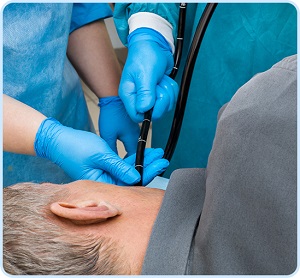
Endoscopic Retrograde Cholangiopancreatography (ERCP) in Sugar Land, Texas
Advanced Evaluation and Treatment of Bile and Pancreatic Duct Disorders
Endoscopic retrograde cholangiopancreatography, or ERCP, is a specialized procedure used primarily to treat blockages and other disorders involving the bile and pancreatic ducts. By combining endoscopy with live X-ray imaging, ERCP can help remove duct stones, open narrowed passages, place stents, and collect tissue samples when necessary.
Dr. Gregory L. Shannon is a board-certified gastroenterologist serving patients in Sugar Land, Texas. He provides comprehensive evaluation for biliary and pancreatic conditions and helps determine when ERCP or another diagnostic or therapeutic procedure may be appropriate. Contact Dr. Shannon’s office for an appointment today!
What is Endoscopic Retrograde Cholangiopancreatography?
Endoscopic retrograde cholangiopancreatography is a treatment method used to diagnose and treat disorders related to the pancreatic and biliary ductal systems as well as the liver, gallbladder, and pancreas. The treatment technique combines endoscopy and fluoroscopy, live X-ray.
Indications of Endoscopic Retrograde Cholangiopancreatography
Some of the indications for ERCP include:
- Treating blockage in the bile or pancreatic ducts due to gallstones, strictures, cancer, or compression from nearby tissues.
- Jaundice (yellowish skin due to blockage of the bile duct).
- Persistent or recurrent upper abdominal pain which cannot be diagnosed by other tests such as MRCP/MRI or CT.
- To confirm diagnosis of pancreatic or bile duct cancer and plan treatment.
Preparation
- You should inform your doctor of any medications, vitamins, or supplements that you are taking.
- Inform your doctor if you have a history of allergy to any medication, anesthetic, or contrast agent.
- Avoid eating and drinking for 8 hours before the procedure.
- Arrange for someone to drive you back home after the procedure.
Procedure of Endoscopic Retrograde Cholangiopancreatography
- You will be asked to lie on an examination table for the procedure.
- The procedure may be performed under sedation and local anesthesia or general anesthesia. An intravenous (IV) needle will be placed in your arm.
- After administering a local anesthetic to the throat, your doctor will insert an endoscope through your mouth, esophagus, and stomach to reach the first part of the intestine called the duodenum where the bile and pancreatic ductal systems open.
- A small camera mounted on the endoscope captures images which are magnified and viewed on a monitor.
- Your doctor will locate the opening where the bile and pancreatic ducts empty into the duodenum.
- A catheter will be inserted through the endoscope into the ducts and a special dye, called a contrast medium, will be injected into the ducts through the catheter to make the ducts more visible on X-rays.
- Fluoroscopy (live X-ray imaging) is performed to identify areas of blockage or other abnormalities.
- Your doctor may then pass tiny tools through the endoscope to open blocked or narrowed ducts and remove or break gallstones.
- Temporary stents may be inserted to keep ducts open or to avoid bile leaks that can occur after gallbladder surgery.
- The procedure often takes between 1 and 2 hours.
Post-operative Care
You will be transferred to the recovery area until the anesthesia wears off. You may experience a sore throat and minor cramps. You can resume eating the next day following the procedure.
Risks and Complications
Some of the risks and complications for endoscopic retrograde cholangiopancreatography include:
- Infection
- Inflammation of the pancreas or gallbladder
- Excessive bleeding
- Duct perforation or damage to the small intestine, esophagus, or stomach
Why Choose Dr. Gregory L. Shannon for ERCP Care?
Coordinated Care for Bile and Pancreatic Duct Conditions
Symptoms of bile or pancreatic duct disease can overlap with those caused by the liver, gallbladder, stomach, and pancreas. Dr. Gregory L. Shannon provides individualized gastroenterology care to identify the possible source of symptoms and determine whether ERCP is an appropriate treatment option.
His approach begins with reviewing your symptoms, medical history, laboratory results, and imaging findings. When ERCP is indicated, care can be coordinated with an appropriately trained endoscopy team and other specialists as needed.
Patients Can Expect:
- Evaluation of suspected bile or pancreatic duct disorders
- Review of liver tests and diagnostic imaging
- Assessment for gallstones, narrowing, obstruction, or bile leakage
- Clear guidance about whether ERCP is medically appropriate
- Coordination of specialized endoscopic treatment when indicated
- Explanation of preparation, benefits, risks, and alternatives
- Follow-up care after treatment
- Coordination with surgeons, radiologists, or oncologists when necessary
Endoscopic Retrograde Cholangiopancreatography (ERCP) – FAQs
What is ERCP used to treat?
ERCP may be used to remove bile duct stones, open narrowed bile or pancreatic ducts, place or replace stents, treat bile leaks, or collect tissue samples from suspicious areas. It is generally reserved for conditions that are likely to benefit from endoscopic treatment.
Is ERCP a diagnostic or treatment procedure?
ERCP was previously used for both diagnosis and treatment, but it is now performed mainly as a therapeutic procedure. Noninvasive tests such as MRI-based MRCP, CT, or ultrasound are often used first to diagnose a possible duct disorder.
How should I prepare for ERCP?
Preparation generally includes avoiding food and beverages for a specified period before the procedure. Tell your medical team about all medications, supplements, allergies, pregnancy, and previous reactions to contrast material or anesthesia. Follow specific instructions regarding blood thinners and diabetes or weight-management medications.
Will I be awake during ERCP?
ERCP is performed with deep sedation or general anesthesia, depending on the facility, procedure, and individual medical needs. Your breathing, heart rate, blood pressure, and oxygen levels will be monitored throughout the procedure.
How long does ERCP take?
The procedure commonly takes approximately one to two hours, although the time varies according to the condition and treatment required. Additional time is needed for preparation and recovery.
Can ERCP remove gallstones?
ERCP can remove stones located in the common bile duct, but it does not remove the gallbladder itself. If gallstones originated in the gallbladder, a surgical consultation for gallbladder removal may still be recommended.
What is an ERCP stent?
A stent is a small tube placed inside a narrowed or blocked bile or pancreatic duct to restore drainage. Some stents are designed for temporary use and must be removed or replaced during a scheduled follow-up procedure.
What are the risks of ERCP?
Potential complications include pancreatitis, infection, bleeding, perforation, and reactions to sedation or contrast material. The medical team will assess your individual risks and explain the expected benefits and available alternatives before the procedure.
Can I drive myself home after ERCP?
No. Because sedation or anesthesia is used, you will need a responsible adult to drive you home. Some patients may require hospital observation or an overnight stay based on the treatment performed and their overall condition.
When should I seek medical care after ERCP?
Seek prompt medical attention for severe or worsening abdominal pain, persistent vomiting, fever, chills, chest pain, difficulty breathing, vomiting blood, black stools, jaundice, or difficulty swallowing. These symptoms may indicate pancreatitis, infection, bleeding, or another complication.
Take the Next Step in Your Biliary and Pancreatic Care
Evaluation, Treatment Planning & Coordinated Gastroenterology Care
Whether you have jaundice, abnormal liver tests, a suspected bile duct stone, or another pancreatic or biliary concern, Dr. Shannon can provide a comprehensive evaluation and determine the appropriate next step. Contact his office in Sugar Land, Texas, for an appointment today.
You will need the Adobe Reader to view and print these documents. 

Gregory L. Shannon, MD
Board-Certified Gastroenterologist Diplomate, American Board of Internal Medicine& Subspecialty Board in Gastroenterology
Gregory L. Shannon, MD, is a board-certified gastroenterologist providing comprehensive care for adults with conditions affecting the digestive system. Practicing in Sugar Land, Texas, he evaluates and treats a broad range of gastrointestinal concerns involving the esophagus, stomach, intestines, colon, liver, biliary system, and pancreas.



